Cross-Validation From Scratch: Why Testing on Training Data Is Cheating
The one technique every model depends on
1. The Problem: How Good Is Your Model, Really?
You build a model. It predicts your training data perfectly. Is it good?
No. It might have just memorized the data. A model that memorizes is useless on new data — like a student who memorizes answers but can’t solve new problems.
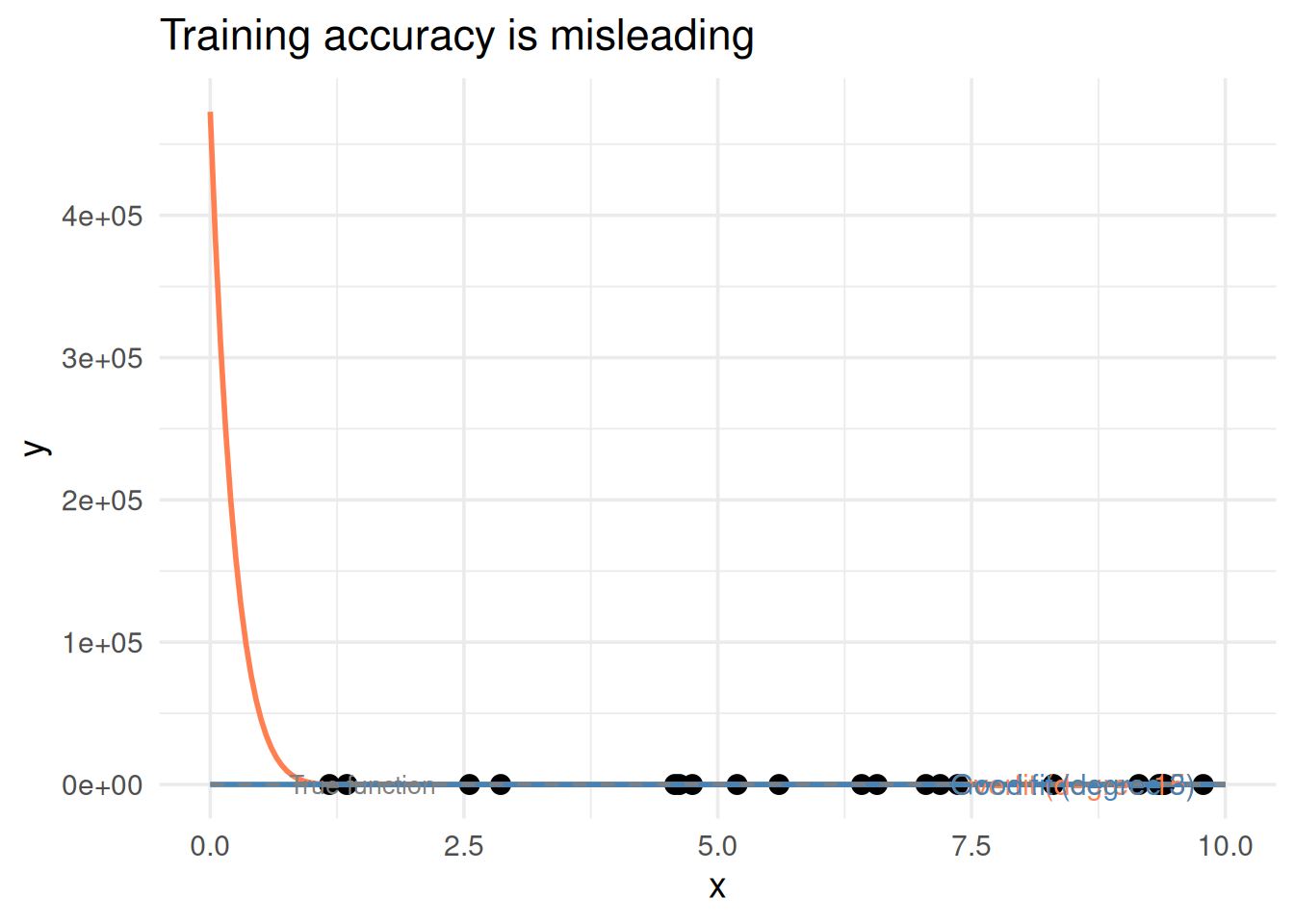
library(ggplot2)set.seed(42)# True relationship: simple curvex <-sort(runif(20, 0, 10))y <-2*sin(x) +rnorm(20, 0, 0.8)df <-data.frame(x = x, y = y)# Overfit model: high-degree polynomialfit_over <-lm(y ~poly(x, 15), data = df)# Good model: low-degree polynomialfit_good <-lm(y ~poly(x, 3), data = df)x_grid <-seq(0, 10, length.out =200)pred_over <-predict(fit_over, newdata =data.frame(x = x_grid))pred_good <-predict(fit_good, newdata =data.frame(x = x_grid))ggplot(df, aes(x, y)) +geom_point(size =3) +geom_line(data =data.frame(x = x_grid, y = pred_over),aes(x, y), color ="coral", linewidth =1) +geom_line(data =data.frame(x = x_grid, y = pred_good),aes(x, y), color ="steelblue", linewidth =1) +geom_line(data =data.frame(x = x_grid, y =2*sin(x_grid)),aes(x, y), color ="gray50", linetype ="dashed") +annotate("text", x =8.5, y =4, label ="Overfit (degree 15)",color ="coral", size =4) +annotate("text", x =8.5, y =-1, label ="Good fit (degree 3)",color ="steelblue", size =4) +annotate("text", x =1.5, y =-2.5, label ="True function",color ="gray50", size =3.5) +theme_minimal(base_size =14) +labs(x ="x", y ="y", title ="Training accuracy is misleading")
Figure 1: The wiggly model fits training data perfectly but is clearly wrong
The red line hits every point — 100% training accuracy. But it’s wildly wrong between the points. The blue line misses some points but captures the real pattern.
How do we tell the difference? We need data the model has never seen.
2. The Simplest Fix: Train/Test Split
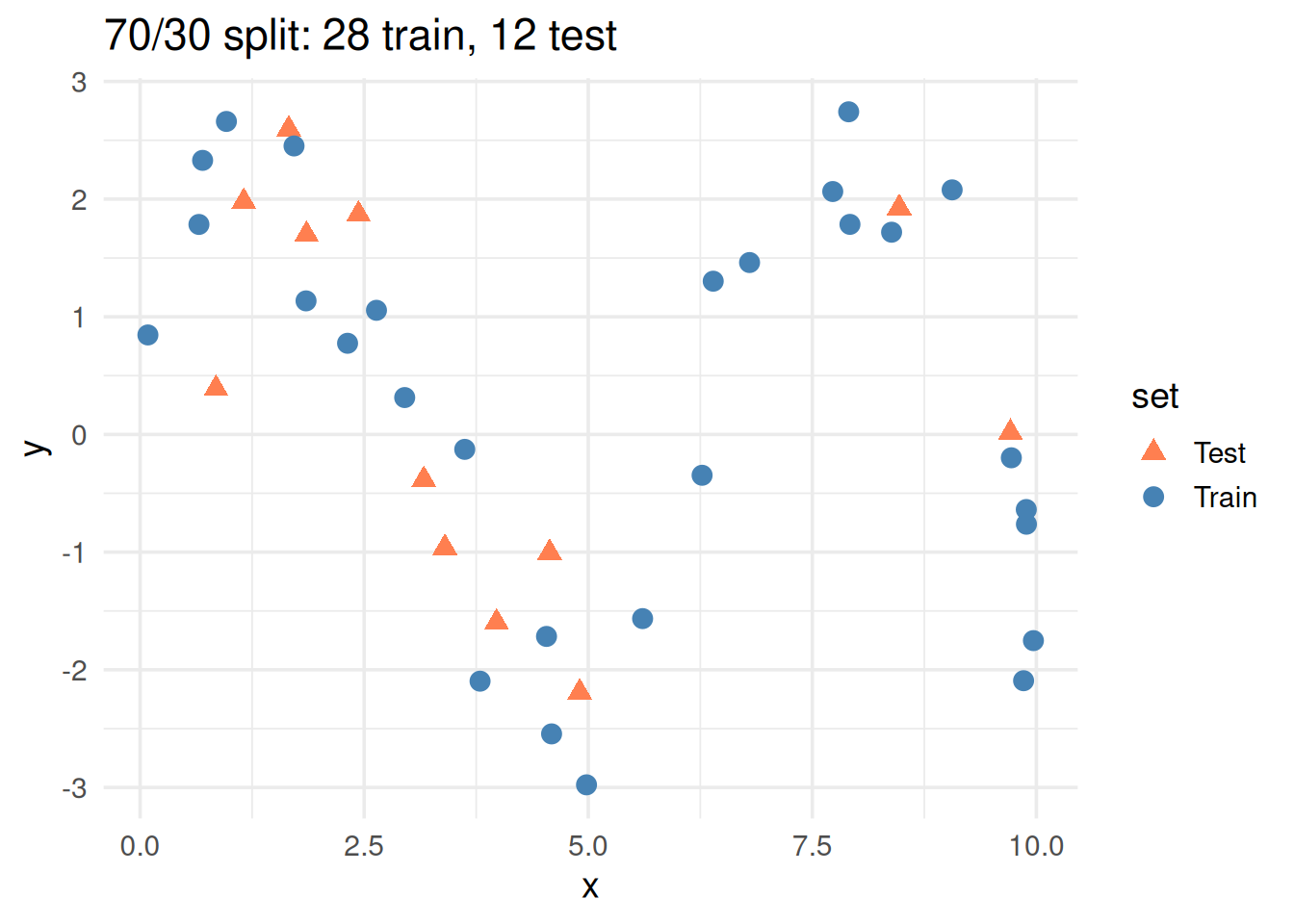
Split your data into two pieces:
Training set (~70-80%): build the model
Test set (~20-30%): evaluate the model
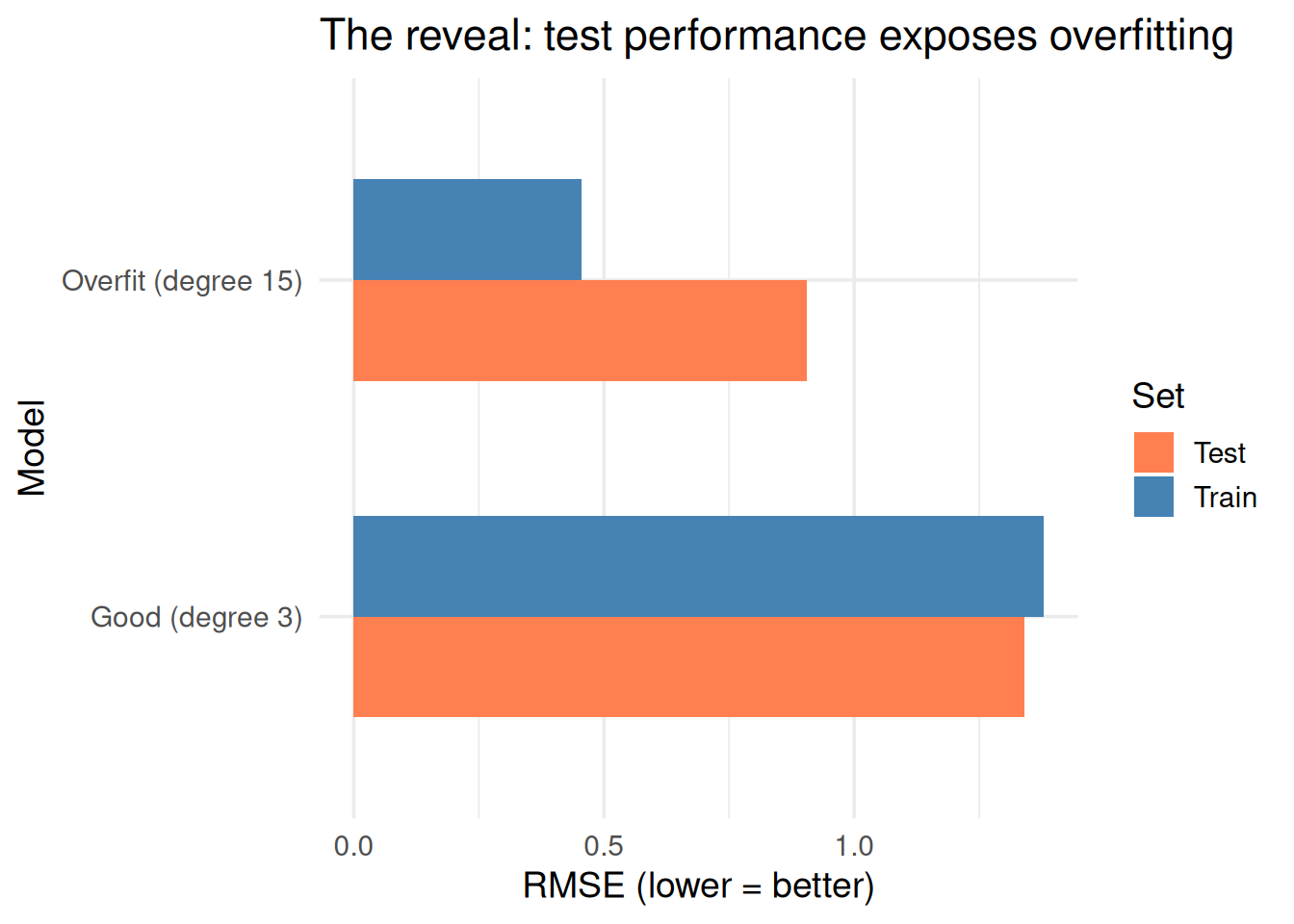
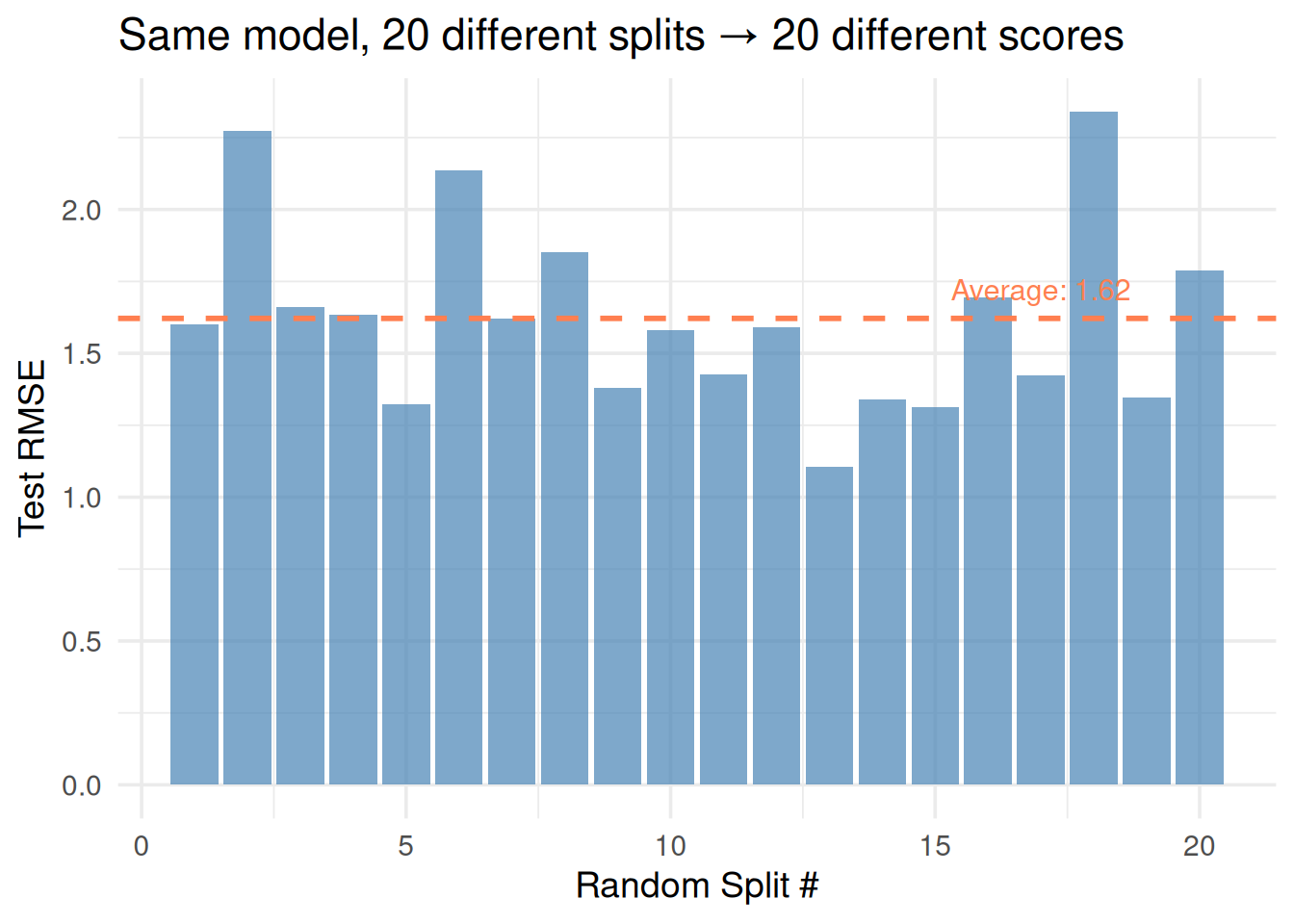
The model never sees the test data during training. Its performance on the test set tells you how it will do on genuinely new data.
For classification, “Error” is usually misclassification rate (% wrong). For regression, it’s usually RMSE or MSE.
4. Choosing k (the Number of Folds)
Confusing but important: this \(k\) is different from KNN’s \(k\). This is the number of folds, not the number of neighbors.
Folds
Name
Train size
Test size
Pros
Cons
5
5-fold
80%
20%
Fast, good balance
Moderate variance
10
10-fold
90%
10%
Better estimate
Slower
\(n\)
Leave-one-out (LOO)
\(n-1\)
1
Uses max training data
Very slow, high variance
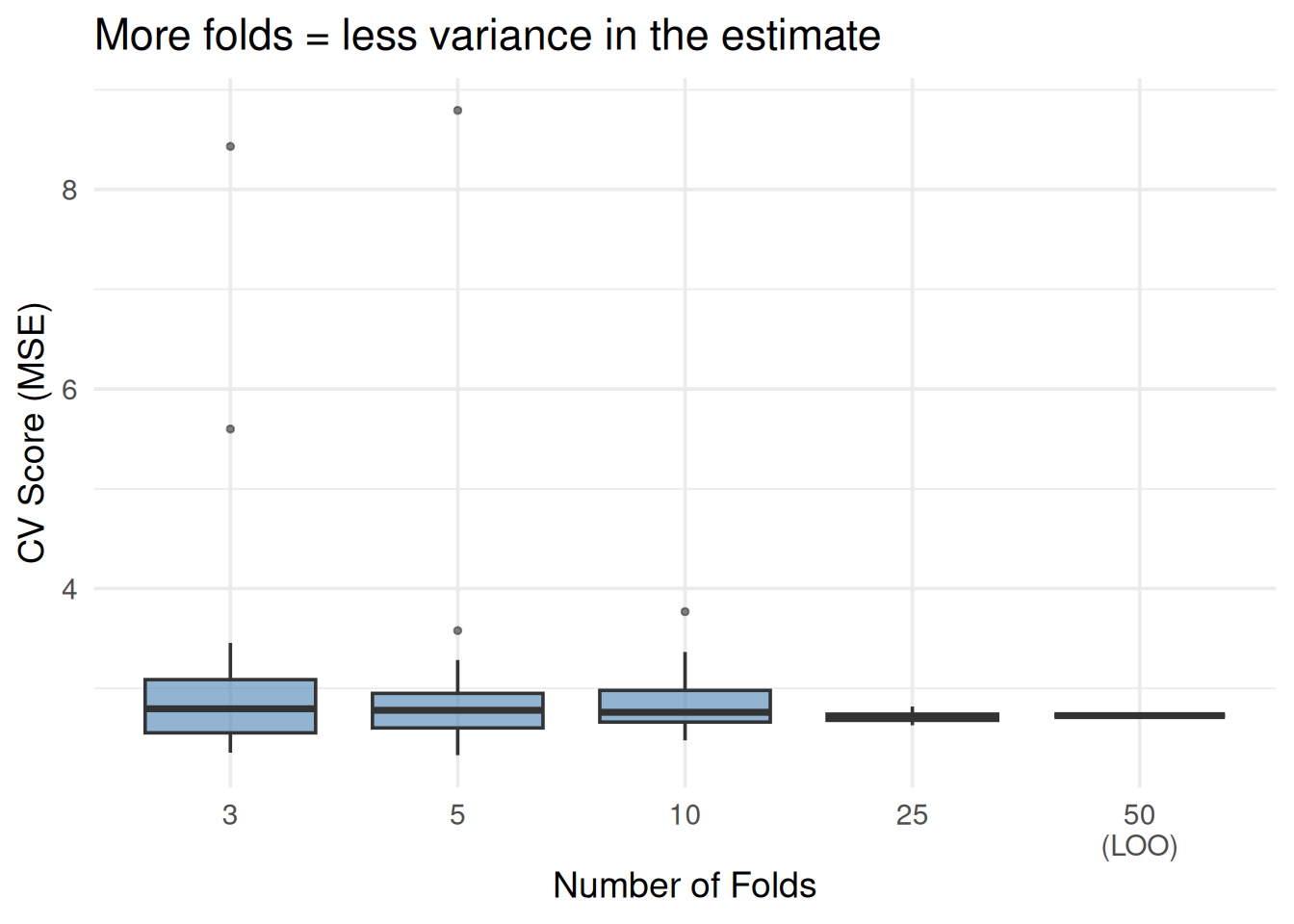
set.seed(42)n <-50x <-sort(runif(n, 0, 10))y <-2*sin(x) +rnorm(n, 0, 0.8)df_cv <-data.frame(x = x, y = y)# Run k-fold CV for different k values, repeat to see variancefold_vals <-c(3, 5, 10, 25, n)fold_labels <-c("3", "5", "10", "25", paste0(n, "\n(LOO)"))results_list <-list()for (fi inseq_along(fold_vals)) { kf <- fold_vals[fi] scores <-sapply(1:30, function(rep) { folds <-sample(rep(1:kf, length.out = n)) errs <-sapply(1:kf, function(f) { train <- df_cv[folds != f, ] test <- df_cv[folds == f, ]if (nrow(train) <4||nrow(test) <1) return(NA) fit <-lm(y ~poly(x, 3), data = train)mean((test$y -predict(fit, test))^2) })mean(errs, na.rm =TRUE) }) results_list[[fi]] <-data.frame(folds = fold_labels[fi],score = scores )}results_all <-do.call(rbind, results_list)results_all$folds <-factor(results_all$folds, levels = fold_labels)ggplot(results_all, aes(folds, score)) +geom_boxplot(fill ="steelblue", alpha =0.6, outlier.size =1) +theme_minimal(base_size =14) +labs(x ="Number of Folds", y ="CV Score (MSE)",title ="More folds = less variance in the estimate")
Figure 6: More folds = more stable estimate, but diminishing returns past 10
Rule of thumb for this guide: Use 5-fold or 10-fold. These are the standard choices and almost always sufficient.
5. What Cross-Validation Is Actually Used For
Cross-validation answers two questions:
Question 1: How good is this model?
“What accuracy will my SVM get on new data?” → Train with CV, report the average score.
Question 2: Which parameter value is best?
This is the primary use in this guide: choosing hyperparameters.
What \(k\) should I use in KNN?
What \(C\) should I use in SVM?
How many components in PCA?
Which variables in regression?
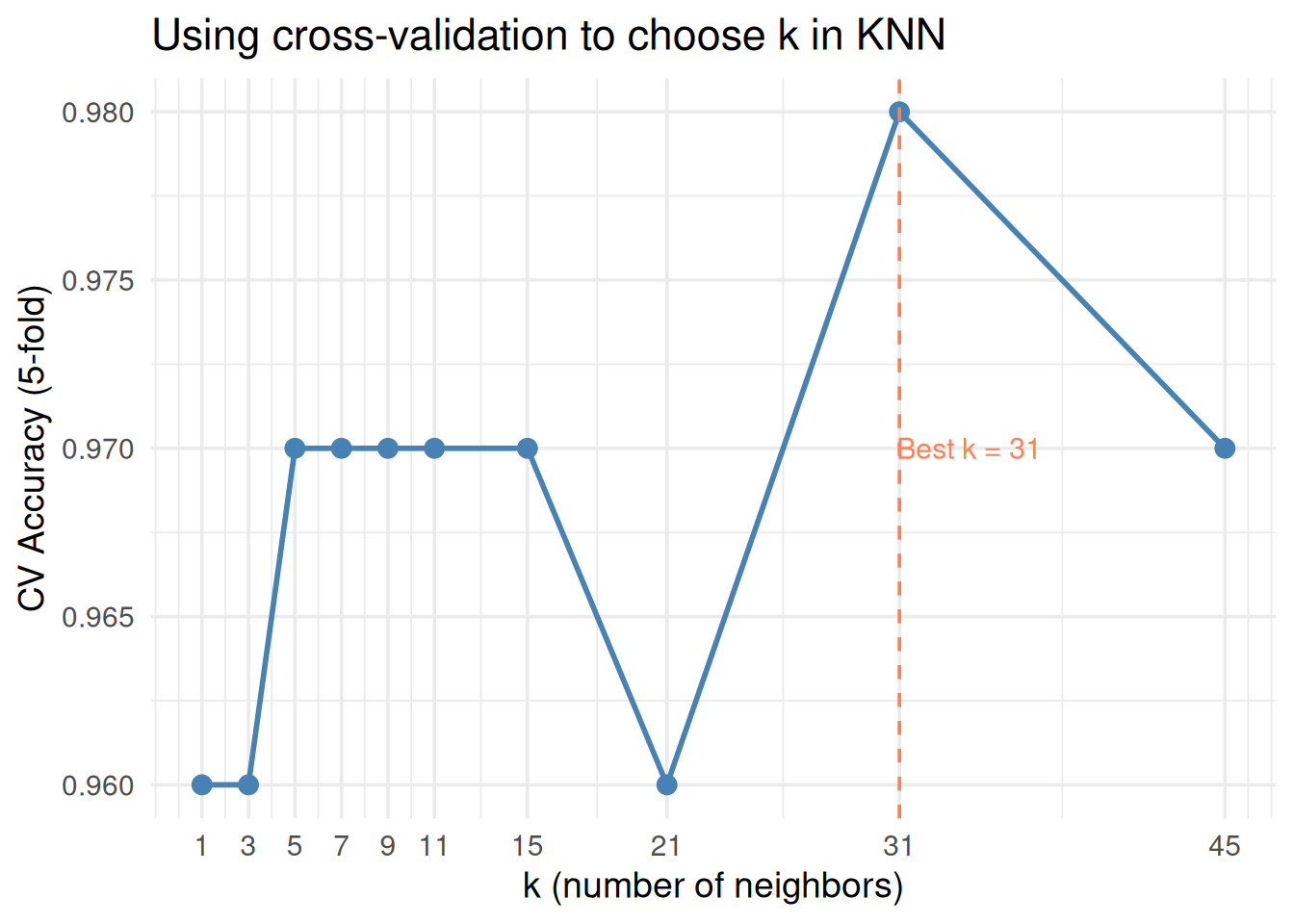
library(class)set.seed(42)# Generate classification datadf_class <-data.frame(x1 =c(rnorm(50, 2, 1), rnorm(50, 4.5, 1)),x2 =c(rnorm(50, 2, 1), rnorm(50, 4.5, 1)),group =factor(rep(c("A", "B"), each =50)))# 5-fold CV for different k valuesk_values <-c(1, 3, 5, 7, 9, 11, 15, 21, 31, 45)n_obs <-nrow(df_class)folds <-sample(rep(1:5, length.out = n_obs))cv_results <-sapply(k_values, function(k_nn) { fold_acc <-sapply(1:5, function(f) { train <- df_class[folds != f, ] test <- df_class[folds == f, ] pred <-knn(train[, 1:2], test[, 1:2], train$group, k = k_nn)mean(pred == test$group) })mean(fold_acc)})best_k <- k_values[which.max(cv_results)]ggplot(data.frame(k = k_values, accuracy = cv_results), aes(k, accuracy)) +geom_line(linewidth =1, color ="steelblue") +geom_point(size =3, color ="steelblue") +geom_vline(xintercept = best_k, linetype ="dashed", color ="coral") +annotate("text", x = best_k +3, y =min(cv_results) +0.01,label =paste0("Best k = ", best_k), color ="coral", size =4) +scale_x_continuous(breaks = k_values) +theme_minimal(base_size =14) +labs(x ="k (number of neighbors)", y ="CV Accuracy (5-fold)",title ="Using cross-validation to choose k in KNN")
Figure 7: Cross-validation finds the best k for KNN by testing each value
library(e1071)
Attaching package: 'e1071'
The following object is masked from 'package:ggplot2':

    element
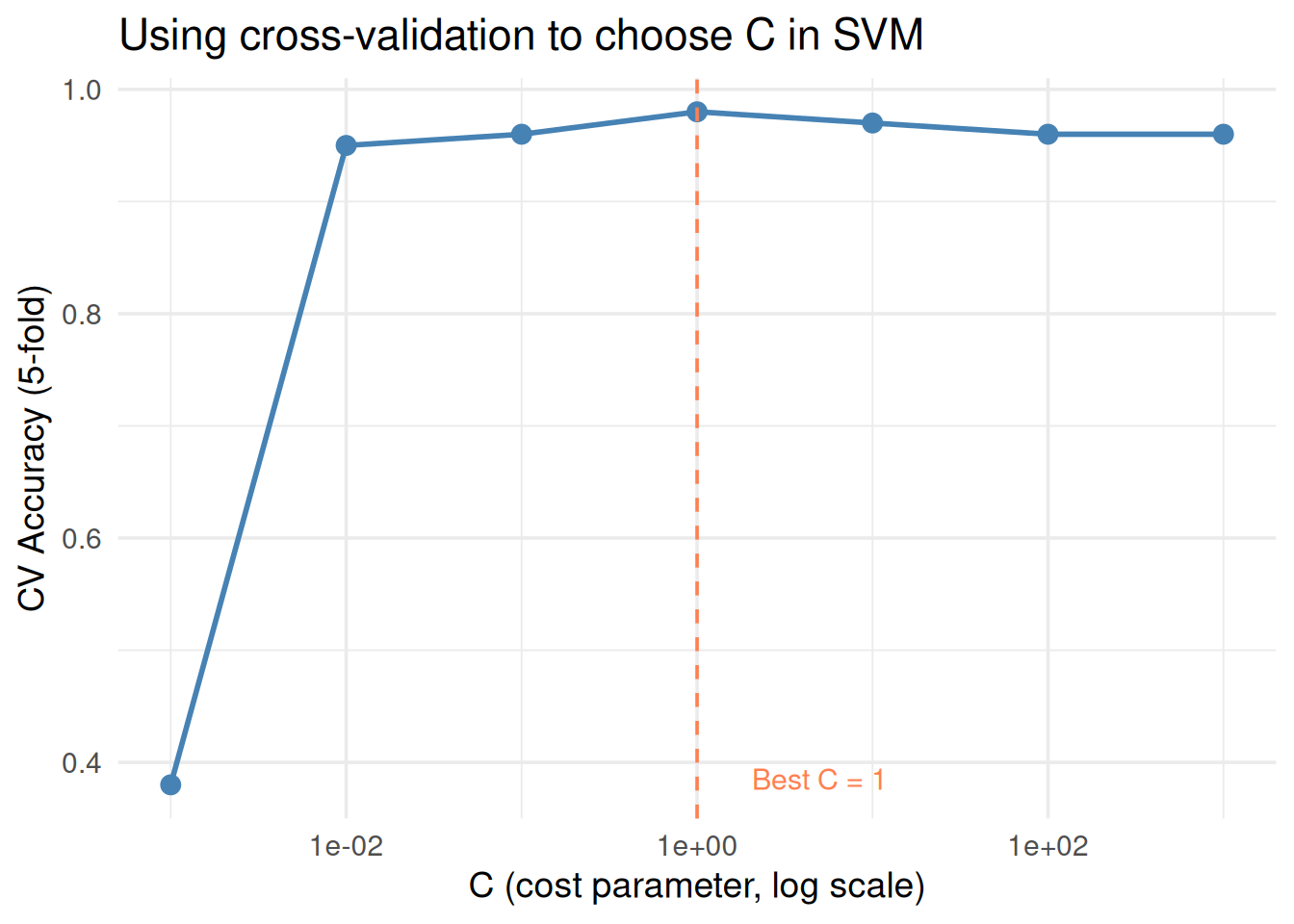
c_values <-c(0.001, 0.01, 0.1, 1, 10, 100, 1000)cv_svm <-sapply(c_values, function(C) { fold_acc <-sapply(1:5, function(f) { train <- df_class[folds != f, ] test <- df_class[folds == f, ] fit <-svm(group ~ x1 + x2, data = train, kernel ="linear", cost = C) pred <-predict(fit, test)mean(pred == test$group) })mean(fold_acc)})best_c <- c_values[which.max(cv_svm)]ggplot(data.frame(C = c_values, accuracy = cv_svm), aes(C, accuracy)) +geom_line(linewidth =1, color ="steelblue") +geom_point(size =3, color ="steelblue") +geom_vline(xintercept = best_c, linetype ="dashed", color ="coral") +annotate("text", x = best_c *5, y =min(cv_svm) +0.005,label =paste0("Best C = ", best_c), color ="coral", size =4) +scale_x_log10() +theme_minimal(base_size =14) +labs(x ="C (cost parameter, log scale)", y ="CV Accuracy (5-fold)",title ="Using cross-validation to choose C in SVM")
Figure 8: Same idea for SVM: cross-validate over different C values
6. The Train / Validate / Test Split
When you use CV to tune parameters, the CV folds become your validation set. You still need a separate test set that was never part of any tuning.
┌──────────────────────────────────────────────────────────┐
│  ALL DATA                                                │
│                                                          │
│  ┌────────────────────────────────┐  ┌────────────────┐  │
│  │  Training + Validation (80%)   │  │  Test Set (20%) │  │
│  │                                │  │                 │  │
│  │  ← cross-validation happens    │  │  ← touched ONCE │  │
│  │    here to tune parameters     │  │    at the very  │  │
│  │                                │  │    end          │  │
│  └────────────────────────────────┘  └────────────────┘  │
└──────────────────────────────────────────────────────────┘
The workflow:
Set aside 20% as the test set (lock it away)
Use the remaining 80% for k-fold CV to choose parameters
Retrain the final model on all 80% with the best parameters
Evaluate once on the test set → this is your reported performance
Why? If you tune on test data, you’re indirectly fitting to it. The test set must be truly unseen.
# Simulate the full workflowset.seed(42)# Step 1: Hold out test settest_idx <-sample(n_obs, round(0.2* n_obs))train_val <- df_class[-test_idx, ]test_final <- df_class[test_idx, ]# Step 2: CV on train_val to find best kfolds_tv <-sample(rep(1:5, length.out =nrow(train_val)))cv_k <-sapply(k_values, function(k_nn) { fold_acc <-sapply(1:5, function(f) { tr <- train_val[folds_tv != f, ] va <- train_val[folds_tv == f, ] pred <-knn(tr[, 1:2], va[, 1:2], tr$group, k = k_nn)mean(pred == va$group) })mean(fold_acc)})best_k_final <- k_values[which.max(cv_k)]# Step 3: Evaluate on test set with best ktest_pred <-knn(train_val[, 1:2], test_final[, 1:2], train_val$group, k = best_k_final)test_acc <-mean(test_pred == test_final$group)cat(sprintf("Best k from CV: %d\n", best_k_final))
cat(sprintf("Final test accuracy: %.1f%%\n", test_acc *100))
Final test accuracy: 100.0%
cat("\nIf these two numbers are close → model generalizes well")
If these two numbers are close → model generalizes well
cat("\nIf test << CV → you overfit during tuning (rare with proper CV)")
If test << CV → you overfit during tuning (rare with proper CV)
7. Common Mistakes (Common Pitfalls)
WarningTrap 1: Testing on Training Data
“Our model achieves 98% accuracy!”
“On what data?”
“The training data.”
Meaningless. A model that memorizes gets 100% on training data.
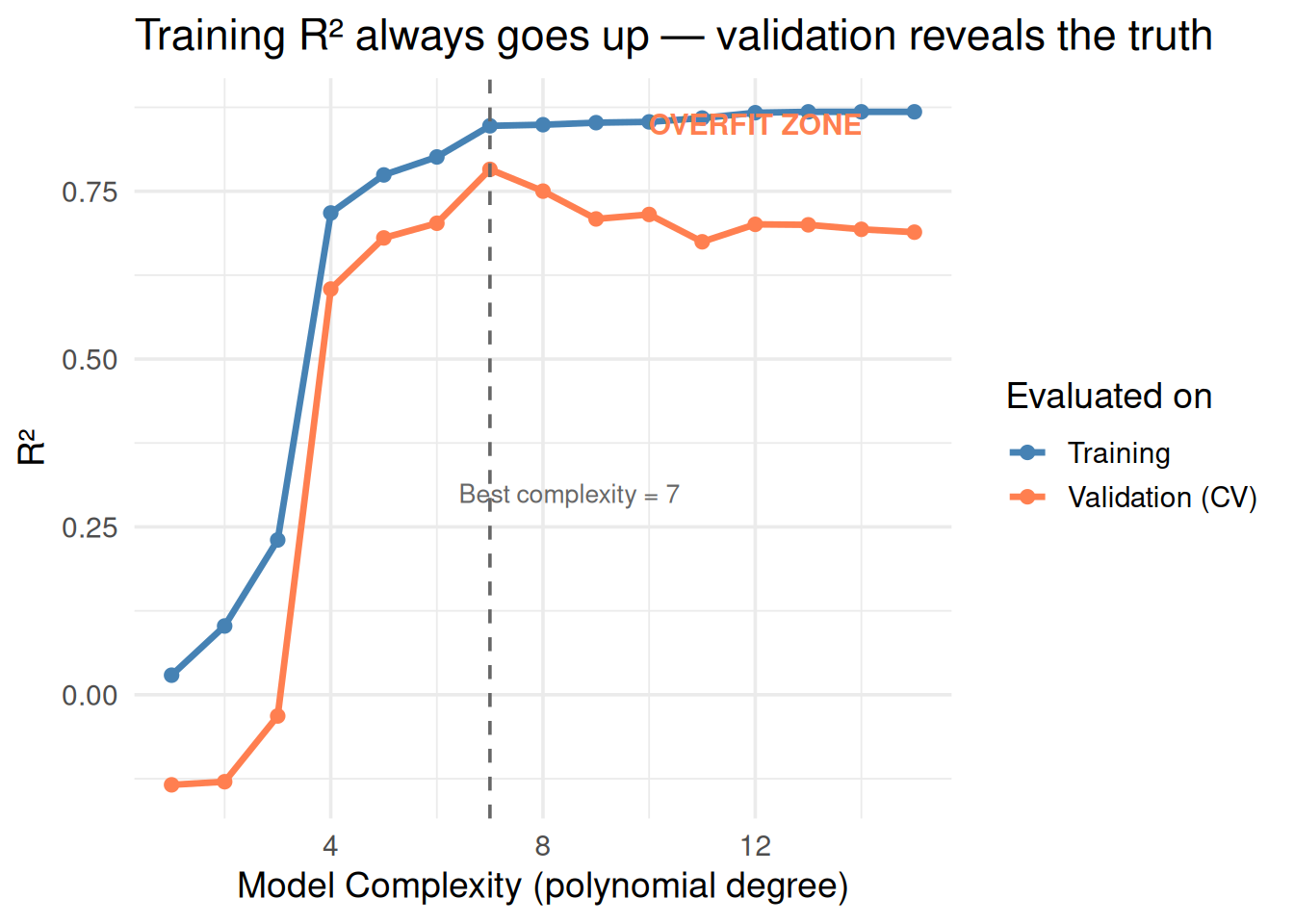
WarningTrap 2: Confusing Training Accuracy with Real Performance
High training accuracy + low validation accuracy = overfitting.
The validation score is the one that matters.
# Show train vs validation accuracy across model complexitycomplexities <-1:15train_acc <-numeric(15)val_acc <-numeric(15)set.seed(42)folds_gap <-sample(rep(1:5, length.out =nrow(df_cv)))for (d in complexities) {# Training accuracy (full data) fit <-lm(y ~poly(x, d), data = df_cv) train_acc[d] <-1-mean(residuals(fit)^2) /var(df_cv$y)# CV accuracy fold_r2 <-sapply(1:5, function(f) { tr <- df_cv[folds_gap != f, ] te <- df_cv[folds_gap == f, ]if (nrow(tr) < d +1) return(NA) fit_cv <-lm(y ~poly(x, min(d, nrow(tr) -2)), data = tr) pred <-predict(fit_cv, te)1-mean((te$y - pred)^2) /var(te$y) }) val_acc[d] <-mean(fold_r2, na.rm =TRUE)}gap_df <-data.frame(complexity =rep(complexities, 2),r_squared =c(train_acc, val_acc),set =rep(c("Training", "Validation (CV)"), each =15))ggplot(gap_df, aes(complexity, r_squared, color = set)) +geom_line(linewidth =1.2) +geom_point(size =2) +scale_color_manual(values =c("steelblue", "coral")) +geom_vline(xintercept =which.max(val_acc), linetype ="dashed", color ="gray40") +annotate("text", x =which.max(val_acc) +1.5, y =0.3,label =paste0("Best complexity = ", which.max(val_acc)),color ="gray40", size =3.5) +annotate("text", x =12, y =0.85, label ="OVERFIT ZONE",color ="coral", size =4, fontface ="bold") +theme_minimal(base_size =14) +labs(x ="Model Complexity (polynomial degree)", y ="R²",color ="Evaluated on", title ="Training R² always goes up — validation reveals the truth")
Figure 9: The gap between training and validation accuracy reveals overfitting
WarningTrap 3: Using Test Data to Tune Parameters
If you try 20 different values of \(k\) on the test set and pick the best one, you’ve fit to the test set. It’s no longer a fair evaluation.
Rule: Test set = used once, at the very end.
WarningTrap 4: Not Enough Data in Each Fold
If \(n = 20\) and \(k = 10\), each test fold has only 2 points. That’s not enough for a reliable error estimate. Use fewer folds with small datasets.
8. Special Case: Leave-One-Out Cross-Validation (LOOCV)
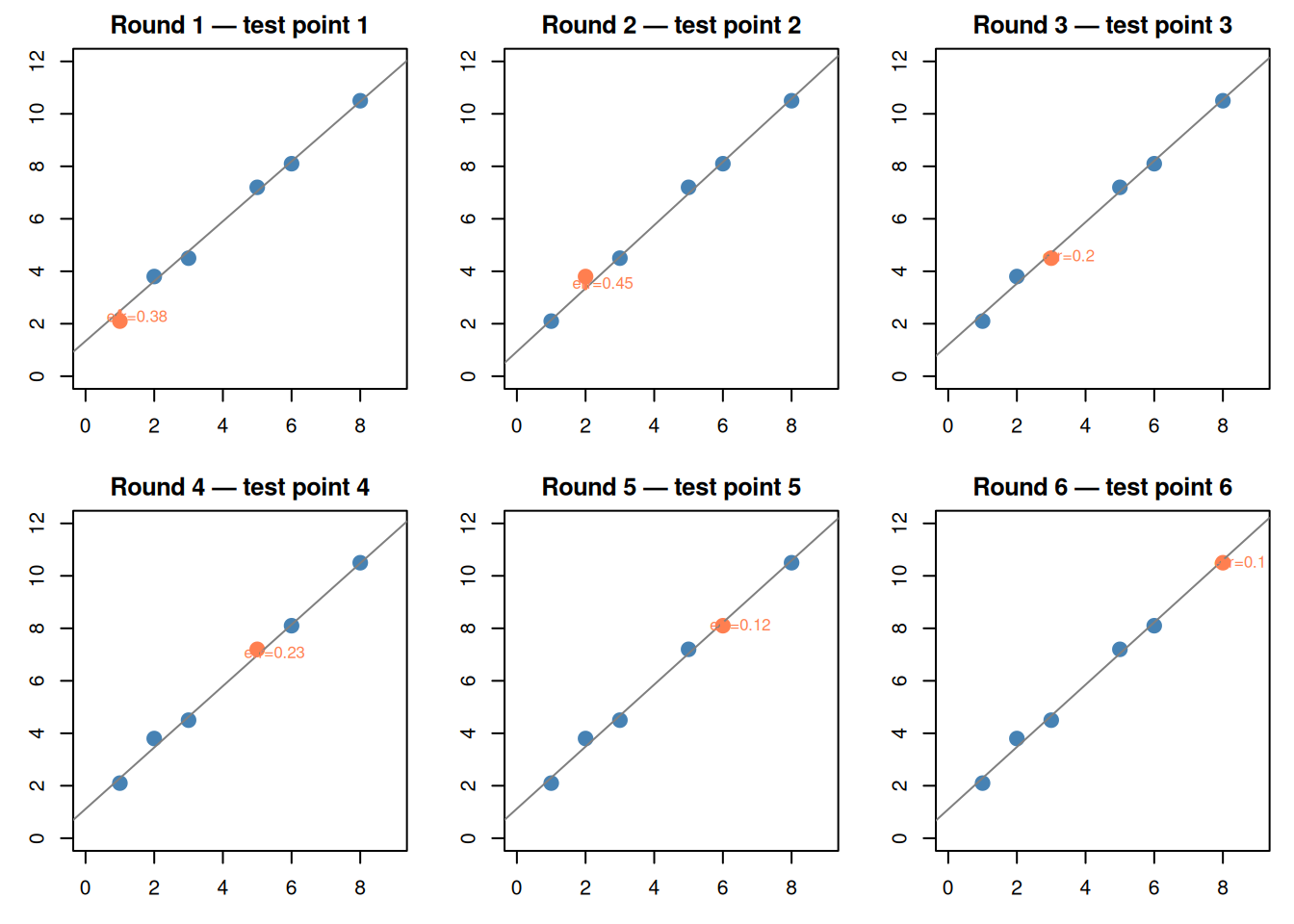
When \(k = n\) (number of folds = number of data points):
Each round: train on \(n-1\) points, test on 1 point
Repeat \(n\) times
Average all \(n\) errors
# Visual: highlight one point at a timepar(mfrow =c(2, 3), mar =c(3, 3, 2, 1))set.seed(42)small_df <-data.frame(x =c(1, 2, 3, 5, 6, 8),y =c(2.1, 3.8, 4.5, 7.2, 8.1, 10.5))for (i in1:6) { train <- small_df[-i, ] test <- small_df[i, ] fit <-lm(y ~ x, data = train)plot(small_df$x, small_df$y, pch =19, cex =1.5,col =ifelse(1:6== i, "coral", "steelblue"),main =paste("Round", i, "— test point", i),xlab ="x", ylab ="y", xlim =c(0, 9), ylim =c(0, 12))abline(fit, col ="gray50") pred <-predict(fit, test)segments(test$x, test$y, test$x, pred, col ="coral", lwd =2, lty =2)text(test$x +0.5, (test$y + pred) /2,paste0("err=", round(abs(test$y - pred), 2)),col ="coral", cex =0.8)}par(mfrow =c(1, 1))
Figure 10: LOOCV: each point gets a turn as the sole test point
LOOCV pros: Uses maximum training data (n-1 points each round). LOOCV cons: Runs \(n\) times (slow for large data), high variance.
When to use: Small datasets where every point matters.
9. Cheat Sheet: The Whole Story on One Page
CROSS-VALIDATION RECIPE
========================

1. PURPOSE: Estimate how well a model generalizes to unseen data

2. k-FOLD CV:
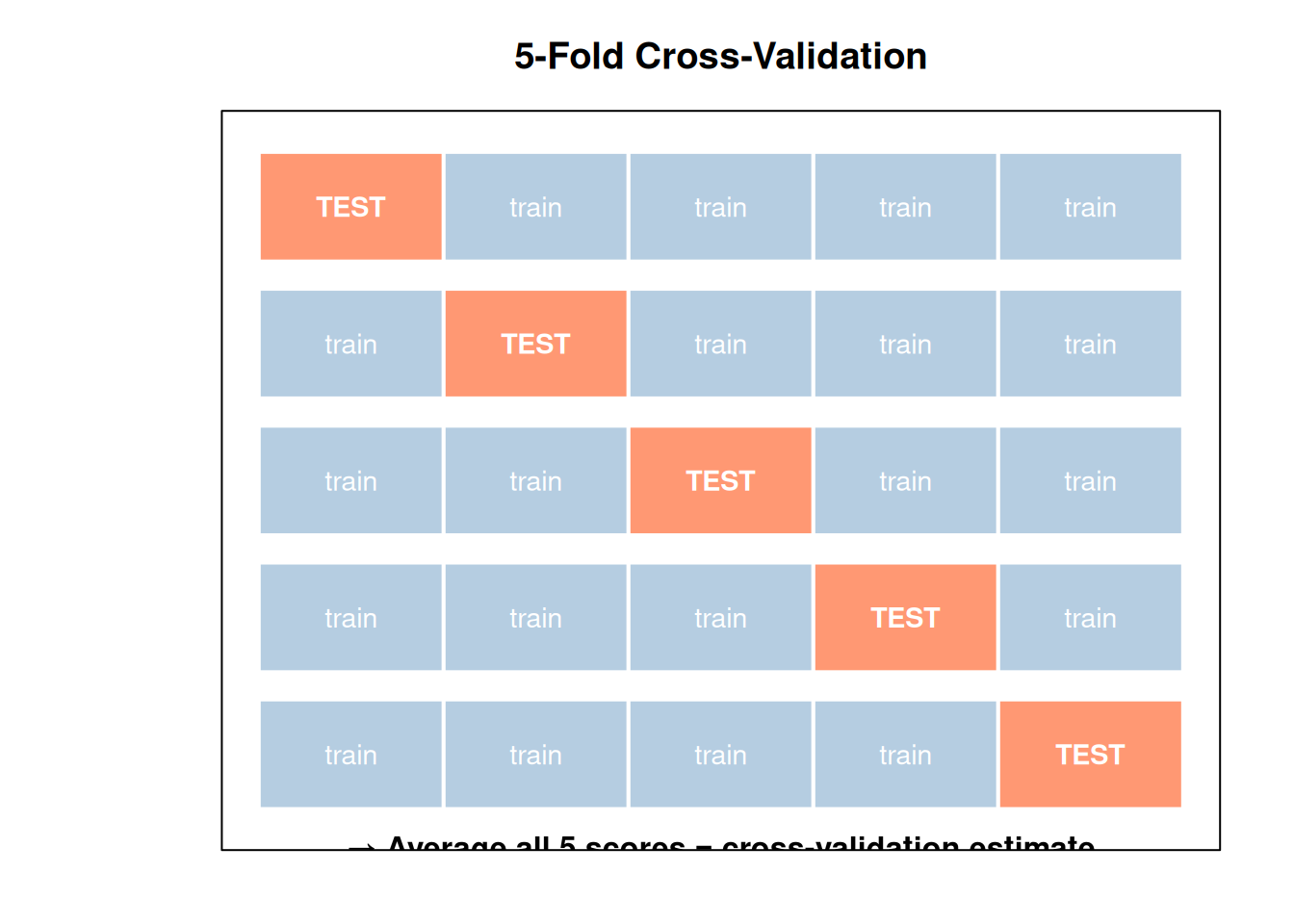
   - Split data into k equal folds
   - Each fold takes a turn as test set
   - Average the k scores
   - Standard choice: k = 5 or k = 10

3. THE FORMULA:
   CV(k) = (1/k) × Σ Errorᵢ

4. PRIMARY USE: Tune hyperparameters
   - KNN: which k (neighbors)?        → CV over k = 1,3,5,7,...
   - SVM: which C (cost)?             → CV over C = 0.01, 0.1, 1, 10,...
   - Regression: which variables?     → CV with different subsets
   - PCA: how many components?        → CV with 1, 2, 3, ... components

5. THREE-WAY SPLIT:
   Training (fit model) → Validation (tune params via CV) → Test (final eval)
   Test set: touched ONCE, at the very end

6. OVERFITTING DETECTION:
   Training accuracy >> Validation accuracy = OVERFIT
   Training accuracy ≈ Validation accuracy = GOOD

7. COMMON PITFALLS:
   - Never evaluate on training data
   - Never tune on test data
   - High training accuracy alone means NOTHING
   - The validation/CV score is what matters
10. Check Your Understanding
NoteTest Yourself
Before moving on, try to answer these without scrolling up:
Why can’t you evaluate a model on its training data?
What does k-fold cross-validation do, step by step?
What’s the difference between the validation set and the test set?
How do you use cross-validation to choose \(k\) in KNN?
You build a model that gets 95% training accuracy and 62% validation accuracy. What’s happening? What would you do?
Why is leave-one-out CV sometimes worse than 10-fold, despite using more training data per round?
A classmate says “I tried 50 different models on the test set and picked the best one.” What’s wrong with this?