Nonparametric tests, Bayesian shrinkage, neural nets, game theory, survival, and gradient boosting
A Fast Tour of Several Modeling Families
This is a greatest-hits tour of methods every analytics practitioner should recognize, even if each one could fill its own deep dive. The goal is not mastery in one sitting; it is vocabulary, intuition, and a working mental hook for where each method belongs.
This demo gives you one working R snippet per area so the names click into the concrete code they map to.
1. Nonparametric Tests
When you don’t know (or can’t assume) an underlying distribution, three go-to tests:
Test
Data
Question
McNemar’s test
Paired binary outcomes
Do two treatments differ?
Wilcoxon signed-rank
Paired or one-sample continuous
Is the median different?
Mann-Whitney U
Two independent samples
Are the distributions different?
McNemar’s test — paired binary outcomes
Two antibiotics tested against 50 bacterial strains each. For each strain, record whether A worked (1/0) and whether B worked (1/0).
The test looks only at disagreement cells. If one treatment dominates the disagreements, the p-value is small.
Wilcoxon signed-rank — paired median comparison
set.seed(7)before <-rnorm(30, mean =100, sd =12)after <- before -rnorm(30, mean =4, sd =6) # slight improvementwilcox.test(before, after, paired =TRUE)
    Wilcoxon signed rank exact test

data:  before and after
V = 416, p-value = 4.968e-05
alternative hypothesis: true location shift is not equal to 0
Mann-Whitney U — unpaired
group_a <-rnorm(40, mean =50, sd =10)group_b <-rnorm(40, mean =55, sd =10)wilcox.test(group_a, group_b, paired =FALSE)
    Wilcoxon rank sum exact test

data:  group_a and group_b
W = 411, p-value = 0.0001311
alternative hypothesis: true location shift is not equal to 0
Tip
Picking the right test: How many samples? If two, paired or unpaired? And what are you asking about (mean, median, success count)? That’s 80% of the decision.
2. Bayesian Modeling — Medical Test Gotcha
Bayes rule:
\[
P(A \mid B) = \frac{P(B \mid A) \cdot P(A)}{P(B)}
\]
The classic medical test example: 98% sensitive, 8% false positive rate, 1% prevalence.
cat("P(disease | positive) =",round(p_disease_given_positive, 4),"(only about 11%!)\n")
P(disease | positive) = 0.1101 (only about 11%!)
Counter-intuitive: after a positive test, you still only have an ~11% chance of having the disease, because the large healthy population creates ~8× more false positives than the sick population creates true positives.
Empirical Bayes shrinkage — NCAA basketball
A sports analytics example: a 20-point home win is actually less than a 50% predictor of the same team winning on the road. Let’s see the shrinkage numbers.
# Parameters from historical NCAA dataH <-4# home-court advantage (points)sigma <-11# SD of random game noisetau <-6# SD of true team-strength differencesobserved_margin <-20# Observed = H + M + noise, so "signal" = observed - H = 16 on top of home court# Shrinkage: posterior mean of M given observation# M | X ~ Normal(posterior_mean, posterior_var)x_minus_h <- observed_margin - Hposterior_var <-1/ (1/ tau^2+1/ sigma^2)posterior_mean <- posterior_var * (x_minus_h / sigma^2)cat("Observed margin: ", observed_margin, "\n")
Observed margin: 20
cat(" - home-court component: ", H, "\n")
- home-court component: 4
cat(" - posterior mean of M: ", round(posterior_mean, 2), "\n")
- posterior mean of M: 3.67
cat(" - attributed to randomness:",round(observed_margin - H - posterior_mean, 2), "\n")
- attributed to randomness: 12.33
cat("P(home team is truly better) =",round(1-pnorm(0, posterior_mean, sqrt(posterior_var)), 3), "\n")
P(home team is truly better) = 0.757
The model attributes ~4 points to home court, only ~3.5 to actual talent, and the rest to noise. That’s shrinkage in action.
3. Communities in Graphs — Louvain Sketch
Louvain maximizes modularity — a measure of how much more tightly nodes are connected within a community than you’d expect by random chance. Each round:
Start with every node in its own community.
Move each node to whichever neighbor community best increases modularity.
Repeat until stable.
Collapse each community into a super-node; go back to step 2.
We’ll hand-compute modularity for a tiny 6-node graph with two obvious communities.
Five hidden neurons, 4 input features, 3 output classes. The interesting thing isn’t the accuracy — it’s how few lines it takes. Training is fast; making it generalize to a new problem (different data distribution, different task) is the hard part.
5. Game Theory — The Prisoner’s Dilemma Gas Station
Two gas stations on the same corner, each choosing $2.50 or $2.00. Cost is $1.00/gal. When prices tie, they split demand. When they differ, the cheaper one captures everything.
d <-1000# total demand in gallonspayoff <-function(p_self, p_other, cost =1.00, d =1000) {if (p_self < p_other) { d * (p_self - cost) } elseif (p_self > p_other) {0 } else { (d /2) * (p_self - cost) }}price_grid <-c(2.00, 2.50)pm <-outer(price_grid, price_grid,Vectorize(function(a, b) payoff(a, b)))rownames(pm) <-paste0("Self_$", price_grid)colnames(pm) <-paste0("Other_$", price_grid)pm
Read the matrix: if the other station charges $2.50, your best move is $2.00 ($1000 vs $750). If they charge $2.00, your best move is still $2.00 ($500 vs $0). So both rational actors land on ($2.00, $2.00) — worse for both than the ($2.50, $2.50) cooperative outcome. Classic prisoner’s dilemma.
Note
Re-run with cost = $1.75: at the higher price each gets $0.75 × 500 = $375; at the lower price each gets $0.25 × 500 = $125. Now the higher price dominates for both players — no defection incentive. Economics, not morals, drive the equilibrium.
6. Natural Language Processing — Why Context Matters
“I blew my nose / chance / horn” — same syntax, three different senses of “blew,” and the last sentence alone has two different meanings. Modern NLP models handle this via context embeddings; the simplest demo is that even tokenization into words is a useful starting point.
sentence <-"I blew my horn and then I blew my chance."tokens <-strsplit(sentence, "\\s+")[[1]]tokens
# Frequency table (the base for bag-of-words models)token_clean <-gsub("[[:punct:]]", "", tolower(tokens))table(token_clean)
token_clean
   and   blew chance   horn      i     my   then
     1      2      1      1      2      2      1
This is the front end of every classical NLP pipeline — tokenize, lowercase, strip punctuation. Modern transformers do much more, but they still start here.
7. Survival Analysis — Cox Proportional Hazards
Survival models predict the probability that an event happens before time \(t\), as a function of covariates. Cox’s proportional hazards model:
# Cox PH: status == 2 means deathfit_cox <-coxph(Surv(time, status) ~ age + sex + ph.ecog, data = lung)summary(fit_cox)$coefficients
               coef exp(coef)    se(coef)         z     Pr(>|z|)
age      0.01106676 1.0111282 0.009267411  1.194159 2.324157e-01
sex     -0.55261240 0.5754446 0.167739054 -3.294477 9.860514e-04
ph.ecog  0.46372848 1.5899912 0.113577266  4.082934 4.447067e-05
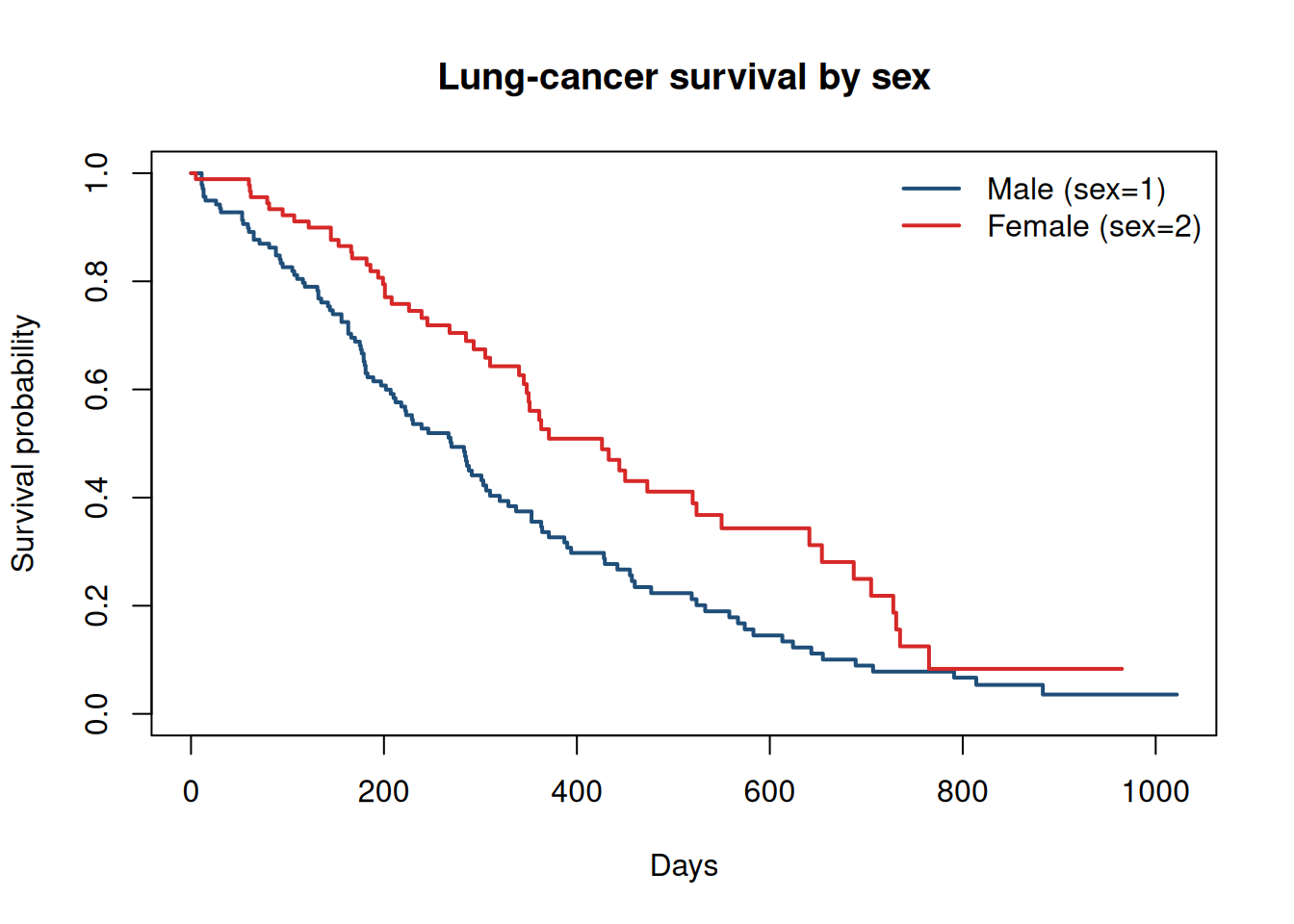
The exp(coef) column is the hazard ratio — \(> 1\) increases hazard (shorter survival), \(< 1\) decreases it. Here sex = 2 (female) has hazard ratio less than 1 — women in this dataset survived longer.
Figure 1: Kaplan-Meier survival curves by sex. The vertical ticks are censored observations — patients still alive when the study ended.
Tip
Censored data — the defining feature of survival analysis. A patient still alive when the study ends has “right-censored” survival time. Cox PH and Kaplan-Meier both handle this naturally; naive regression on survival time does not.
8. Gradient Boosting — Iterative Error Correction
Gradient boosting builds a strong learner by adding weak learners that each fit the residual errors of the current ensemble.
Pseudocode: 1. Start with \(F_0(x)\) = a simple baseline (the mean works fine). 2. Compute the negative gradient of the loss at each training point. For squared error, this is just the residuals. 3. Fit a small learner \(h_k(x)\) to those residuals. 4. Update: \(F_{k+1}(x) = F_k(x) + \gamma \cdot h_k(x)\). 5. Repeat.
Let’s use the gbm package on a nonlinear regression problem.
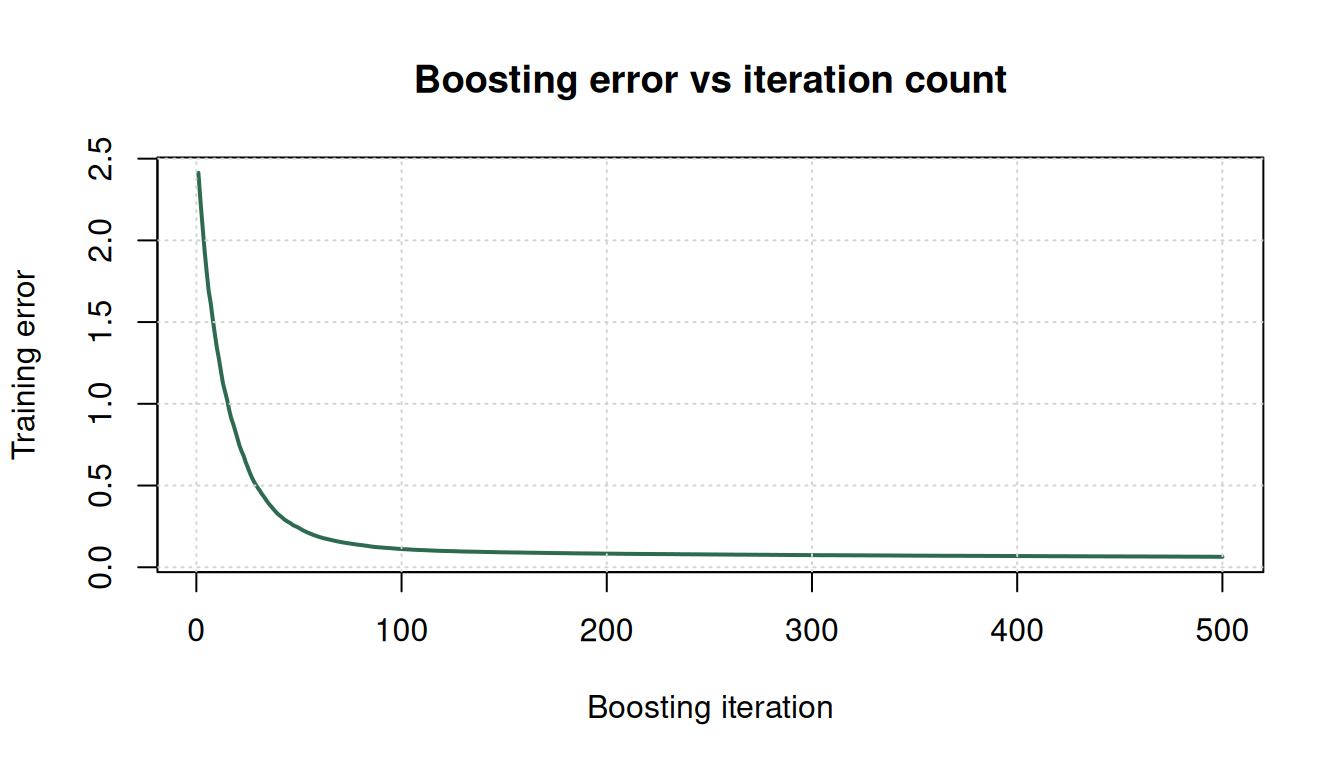
Figure 2: Training error as a function of number of boosting iterations. Classic shape: error drops fast, then plateaus. Stop too early and you underfit; go too long and you overfit.
A Tiny Hand-Worked Gradient Boosting Example
This toy example walks through four data points and shows one full boosting iteration converging from squared error 2.0 to 0.04 with an optimal step size \(\gamma^* = 0.56\). Let’s replicate the key move — optimizing \(\gamma\) analytically — on a toy dataset.
# Four points: F_0 predictions and residualsy_true <-c( 4, 5, 3, 1)F_0_pred <-c(3.5, 5.5, 2.0, 1.5) # base model predictionsresiduals <- y_true - F_0_predresiduals
cat("SSE after boosting step:", round(sse_after, 4), "\n")
SSE after boosting step: 0
When \(H_0\) perfectly fits the residuals, \(\gamma^* = 1\) and the error drops to zero. With imperfect fit (realistic case), \(\gamma^*\) is smaller and the error drops by less — but every iteration improves the prediction.
Cheat Sheet
Topic
When to use
Key R tool
McNemar
Two paired binary outcomes
mcnemar.test()
Wilcoxon
Medians (paired or one-sample)
wilcox.test(paired = TRUE)
Mann-Whitney
Two independent distributions
wilcox.test()
Empirical Bayes
Lots of general data + little specific data
compute shrinkage by hand
Louvain
Find communities in a graph
igraph::cluster_louvain() (not shown — install for real use)
Neural network
Pattern recognition where rules aren’t expressible
nnet::nnet()
Game theory
Agents who react to your decisions
enumerate payoff matrix
NLP
Unstructured language data
tm / quanteda / transformers
Cox PH
Time-to-event with covariates
survival::coxph()
Gradient boosting
Tabular prediction with complex interactions
gbm / xgboost
Warning
Common pitfalls recap:
Base rate fallacy. Even a 98% sensitive test on a 1% prevalence disease gives only ~11% posterior probability of disease after a positive result.
Shrinkage is not intuitive. Extreme observed margins usually mean noise, not talent gaps.
Paired vs unpaired. Wilcoxon has both forms — pick based on whether the data comes in matched pairs.
Censoring. Never run plain regression on survival data — it discards the information from still-alive subjects.
Boosting overfits. Training error monotonically decreases but test error eventually climbs. Use early stopping or CV to pick number of iterations.
Game-theoretic equilibria are not always cooperative. The prisoner’s dilemma equilibrium is worse for everyone than the cooperative outcome.